

Why choose custom eyewear: style, comfort and sustainability
TL;DR:
- Custom eyewear offers a precise fit, enhanced comfort, and personalized style options.
- It improves visual clarity by optimizing lens positioning and reducing distortion.
- While more expensive upfront, it provides longer-lasting durability and sustainability benefits.
Most adults assume their glasses fit well enough. Yet two-thirds wear ill-fitting frames without realising it, accepting daily discomfort as normal. Slipping nose pads, pressure behind the ears, and blurred peripheral vision are not minor inconveniences. They are signs that mass-produced eyewear was never designed for your face. Custom eyewear addresses this directly, using precise measurements and personalised design to deliver genuine fit, sharper vision, and frames that reflect your style. This article covers the practical benefits, real performance data, sustainability credentials, and honest cost considerations you need before making a decision.
Table of Contents
- What makes custom eyewear different?
- The comfort and performance advantage
- Personal style and sustainability: custom makes it possible
- Cost, durability, and delivery: is custom eyewear worth it?
- What most glasses articles don’t tell you about custom eyewear
- Ready to upgrade? Start with premium eyewear options
- Frequently asked questions
Key Takeaways
| Point | Details |
|---|---|
| Perfect personalised fit | Custom eyewear is designed precisely for your facial features, maximising comfort and stability. |
| Improved vision performance | Tailored lenses and design reduce distortion and fatigue for all-day wearing. |
| Style and sustainability | Endless personalisation options and eco-friendly materials allow you to look good and feel responsible. |
| True value over time | Higher initial costs are offset by greater durability and fewer replacements. |
What makes custom eyewear different?
Off-the-shelf frames are manufactured to fit an average face. That average does not exist in reality. Faces vary in bridge width, temple length, pupil distance, and even subtle asymmetry between the left and right sides. Standard frames account for none of this.
Custom eyewear uses a different process entirely. Brands use facial measurements, 3D scans, or parametric design software to build frames around your specific dimensions. Precision fit and comfort are the direct result, eliminating slippage, pressure points, and the constant adjustments that most glasses wearers accept as routine. Understanding eyewear fit and comfort is the first step toward knowing whether custom is right for you.
Who benefits most? People with progressive lenses, high prescriptions, or noticeable facial asymmetry gain the clearest advantage. Children, adults with narrow or wide faces, and anyone who has never found a comfortable off-the-shelf frame also benefit significantly.
| Feature | Custom eyewear | Off-the-shelf |
|---|---|---|
| Fit accuracy | Tailored to your face | Generic sizing |
| Comfort | Pressure-free, no slippage | Variable |
| Style options | Unlimited | Limited range |
| Cost | £120–£480 / $150–$600 | £20–£150 |
| Turnaround | 2 days to 4 weeks | Immediate |
Key features that only custom eyewear provides:
- Exact pupil distance alignment for sharper vision
- Hypoallergenic material options including titanium and bio-acetate
- Personalised colour, shape, and hardware choices
- Asymmetry correction for uneven facial features
- Optimised temple and bridge fit for all-day wear
“The majority of glasses wearers experience some degree of ill-fitting frames. Custom eyewear resolves this by building to the individual, not the average.”
Pro Tip: If your glasses slip down your nose within an hour of wearing, or you feel pressure behind your ears by midday, those are reliable signs that a custom fit would make a measurable difference.
The cost of 3D-printed frames has dropped considerably in recent years, making custom options more accessible than most people expect.
The comfort and performance advantage
Fit is only part of the story. How lenses are positioned within a frame determines visual clarity just as much as the prescription itself. Custom eyewear accounts for variables that standard dispensing often overlooks.
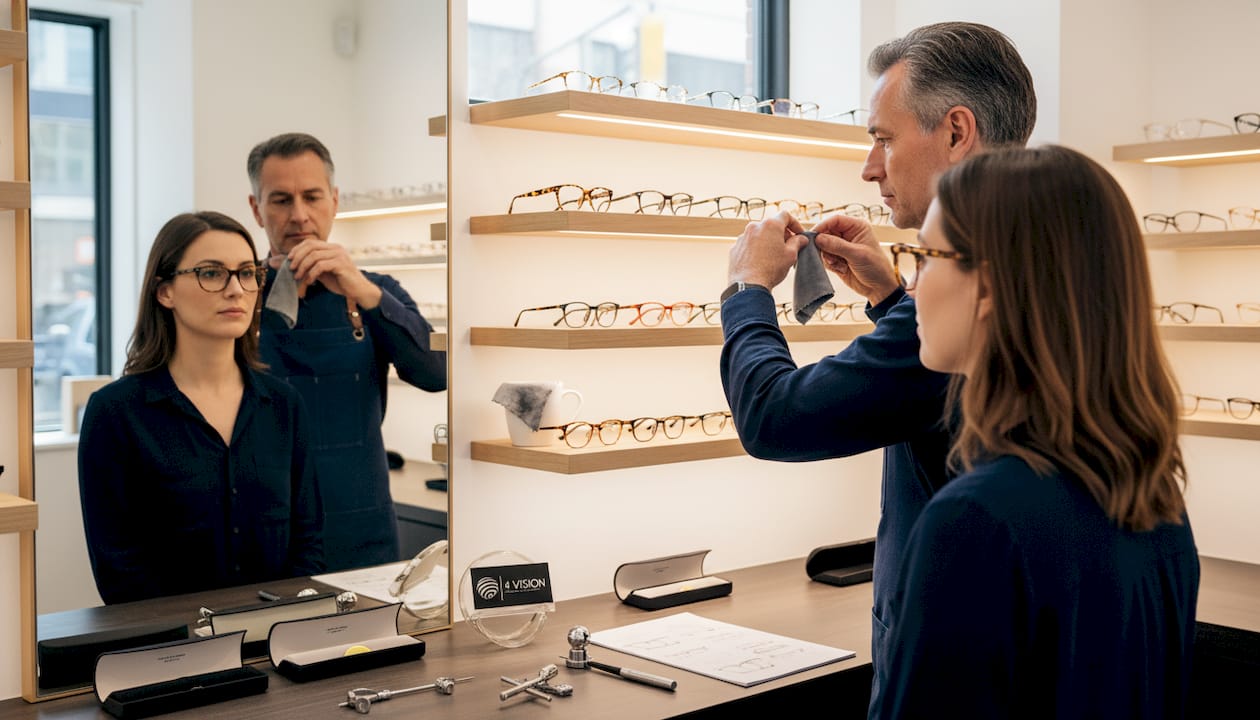
Vertex distance refers to the gap between the lens and your eye. Pantoscopic tilt describes the angle at which the lens sits relative to your face. Both affect how light passes through the lens and reaches the retina. Tailored lenses with optimal tilt and vertex distance reduce distortion and improve the usable clear zone, particularly for progressive and high-prescription lenses.
| Performance metric | Custom eyewear | Generic frames |
|---|---|---|
| Clear vision zone | Maximised | Reduced |
| Distortion at edges | Minimal | Common |
| Adaptation period | Shorter | Longer |
| Fatigue after 8 hours | Low | Moderate to high |
The steps to a comfort-first fitting process:
- Full facial measurement or 3D scan
- Pupil distance measured binocularly and monocularly
- Pantoscopic tilt and vertex distance recorded
- Lens design selected to match prescription and frame geometry
- Frame built or adjusted to confirmed measurements
- Final fit check and minor adjustments
The science behind custom eyewear confirms that wearers of bespoke progressive lenses report fewer adaptation problems compared to those using standard varifocals. Daily wearers also report noticeably less eye fatigue by the end of the day.
Exploring premium eyewear features helps clarify which lens and frame specifications contribute most to long-term comfort.
Pro Tip: If you have a prescription above +/- 4.00 dioptres, or wear progressive lenses, always request custom lens positioning. The difference in clarity and comfort is not marginal. It is significant.
Readers who want to understand more about fit for comfort and clarity will find practical guidance on what to look for when selecting frames.
Personal style and sustainability: custom makes it possible
Beyond fit and optics, custom eyewear opens creative and ethical possibilities that mass-produced frames simply cannot match.
Style choices with custom eyewear are genuinely unlimited. Frame shape, colour, material, hinge style, and even engraving are all adjustable. You are not selecting from a pre-set catalogue. You are specifying a product built around your preferences. This matters for people who have never found a frame that feels authentically theirs.
Sustainability is the other major advantage. 3D printing reduces material waste by 80 to 90 percent compared to traditional subtractive manufacturing, where excess material is cut away and discarded. Brands using recycled and bio-based materials lower their carbon footprint further.
Sustainable material options available in custom eyewear:
- Bio-acetate derived from plant-based sources
- Recycled titanium from aerospace and industrial waste
- Ocean plastic reclaimed from coastal collection programmes
- Reclaimed wood for limited-edition and artisan frames
- Recycled stainless steel for lightweight, durable builds
Brands such as Waterhaul use frames from ocean plastic, reclaimed from Cornish fishing nets. SunGod offers a lifetime guarantee and a recycling scheme for end-of-life frames. These are not marketing gestures. They represent measurable reductions in waste and carbon output.
Pro Tip: Before ordering, ask the brand directly about their supply chain and end-of-life recycling policy. A credible custom eyewear provider will answer clearly. Vague responses about being “eco-friendly” without specifics are a warning sign.
For readers interested in the broader picture, eyewear style and sustainability covers how quality and environmental responsibility connect. Guidance on choosing eyewear sustainably provides practical steps for making informed purchasing decisions.
Cost, durability, and delivery: is custom eyewear worth it?
With style and sustainability covered, it is time to consider what custom eyewear means for your budget and day-to-day life.
The upfront cost is higher. Custom frames typically range from £120 to £480 in the UK and $150 to $600 in the US, depending on materials and lens complexity. Mass-market alternatives start much lower. However, durability and fewer replacements mean the total cost over three to five years is often comparable, and sometimes lower.
| Factor | Custom eyewear | Mass-market |
|---|---|---|
| Upfront cost | £120–£480 / $150–$600 | £20–£150 |
| Expected lifespan | 5–10 years | 1–3 years |
| Replacement frequency | Low | High |
| UK delivery | 1–2 days (some D2C brands) | Same day |
| US delivery | 2–4 weeks | 1–5 days |
Steps to calculate total cost of ownership:
- Note the upfront price of your chosen custom frame
- Estimate how many years you expect it to last
- Compare against how often you replace standard frames
- Factor in any repair or adjustment costs
- Include lens replacement if your prescription changes
SunGod backs its frames with a lifetime guarantee. Waterhaul uses recycled ocean plastic with a documented durability record. Both brands show that premium materials and ethical sourcing do not require compromise on longevity.
For readers who want fast access to quality frames, fast delivery eyewear outlines what to expect from direct-to-consumer brands. Information on eyewear durability explains which materials and construction methods last longest.
One practical note: if you need a backup pair with a low or simple prescription, a well-made mass-market option is a sensible choice. The best online prescription glasses guides can help identify reliable options at that level.
What most glasses articles don’t tell you about custom eyewear
Most guides present custom eyewear as universally superior. The reality is more nuanced, and knowing the difference saves you money and disappointment.
Not all custom eyewear is genuinely bespoke. Some brands apply the term to minor size variations or colour choices, with no actual facial measurement involved. That is not custom. It is marketing. Truly custom eyewear involves validated measurements, documented fitting data, and a frame built to those specifications.
Where custom is clearly worth it: high prescriptions, progressive lenses, facial asymmetry, and anyone who has never found a comfortable standard frame. The custom excels for edge cases argument is well supported by clinical data on adaptation rates and wearer satisfaction.
Where it may not be essential: simple, low-prescription backup pairs. In those cases, a quality mass-market or semi-custom option delivers adequate performance at a fraction of the cost.
The smartest approach for most people is a hybrid: invest in custom for your primary daily pair, and keep a reliable value pair for travel or emergencies. Ask any brand you consider for real-world performance data, not just product photography. A brand confident in its results will share specifics. Understanding when quality is essential helps you apply that judgement consistently. You can also review when custom frames are worth it for a science-based breakdown of specific use cases.
Ready to upgrade? Start with premium eyewear options
If you are considering a new level of vision and style, 4 Vision offers a range of premium, stylish, and durable eyewear options without the luxury markup. Whether you are looking for everyday frames, reading glasses, or sunglasses, the selection covers a wide range of styles, materials, and fits.
Start by reviewing the premium eyewear guide to understand what separates quality frames from the rest. Browse the reading glasses collection for precision-crafted options across multiple styles, or explore the sunglasses selection for UV-protective, fashion-forward designs. Fast delivery, honest pricing, and carbon-neutral shipping are standard across all orders.
Frequently asked questions
Is custom eyewear more expensive than standard glasses?
Custom eyewear costs more upfront, typically £120 to £480 in the UK, but superior durability and fewer replacements mean the long-term value is often comparable to repeatedly replacing cheaper frames.
How do I know if I need custom eyewear?
If you experience slipping, pressure, or visual discomfort, or if you have a high prescription, progressive lenses, or an unusual face shape, custom is the practical choice. Facial measurements and 3D scans ensure the frame and lenses are built specifically for you.
Are all custom eyewear providers truly bespoke?
No. Some brands use the term loosely to describe minor size variations. Genuine custom eyewear involves real measurement and validation data, not just a colour choice or a size label.
How fast can custom eyewear be delivered?
Some direct-to-consumer brands offer 1 to 2 day tracked delivery within the UK. Full custom builds in the US typically take 2 to 4 weeks depending on lens complexity and frame materials.