

Why wear sunglasses? Protect your eyes in style for less
TL;DR:
- UV protection is essential year-round to prevent long-term eye damage like cataracts and macular degeneration.
- Not all sunglasses provide adequate UV protection; look for UV400 rated lenses for full safety.
- Protecting children’s eyes early reduces risks of serious eye diseases later in life.
UV damage to your eyes does not stop when summer ends. In fact, sunglasses protect eyes from cataracts, macular degeneration, and other serious conditions year-round. Many people treat sunglasses as a seasonal fashion item, something to grab before a beach holiday and forget the rest of the year. That approach leaves your eyes exposed to cumulative harm that builds silently over decades. This guide covers the real risks of UV exposure, how different lenses work, when protection matters most, and how to find stylish, affordable sunglasses that do the job properly.
Table of Contents
- The true risks of UV exposure: More than meets the eye
- How sunglasses work: Not all lenses are created equal
- When and where is UV protection crucial?
- Stylish and affordable: Sunglass choices for health and fashion
- Why smart sunglass choices should be non-negotiable: Our expert take
- Find your perfect pair: Premium protection meets style
- Frequently asked questions
Key Takeaways
| Point | Details |
|---|---|
| UV safety matters | Wearing sunglasses with proper UV protection can help prevent eye diseases like cataracts, even on cloudy days. |
| Quality beats price | Affordable sunglasses can deliver full eye protection and style if they are UV400 rated and reliably sourced. |
| Fashion and function | Modern designs let you express your personality while keeping your eyes healthy for the long-term. |
| Early habits help | Protecting children’s eyes from UV damage ensures healthier vision later in life. |
The true risks of UV exposure: More than meets the eye
While many believe sunglasses are just a fashion accessory, the health consequences of skipping them can be severe. UV radiation reaches your eyes in two main forms: UVA and UVB. Both penetrate the eye’s surface and cause oxidative stress, cataracts, and macular degeneration over time. The damage is cumulative, meaning every unprotected hour outdoors adds to a lifetime total your eyes cannot recover from.
The conditions linked to long-term UV exposure include:
- Cataracts: Clouding of the eye’s lens, the leading cause of preventable blindness worldwide
- Age-related macular degeneration: Deterioration of central vision, often irreversible
- Photokeratitis: Essentially sunburn on the cornea, causing temporary but painful vision loss
- Pterygia: Fleshy tissue growths on the white of the eye, sometimes requiring surgery
- Eyelid skin cancers: The thin skin around the eye is highly vulnerable to UV-related cell damage
One of the most persistent myths is that only fair-skinned or light-eyed people need protection. UV radiation damages all eye types regardless of pigmentation. Another common misconception is that eye health dangers only arise in strong sunlight. In reality, UV penetrates clouds and reflects off surfaces like water, sand, and pavements even on overcast days.
“UV exposure is not limited to sunny days or summer months. Consistent protection throughout the year is the only reliable way to reduce cumulative eye damage.”
Children are especially vulnerable. Their crystalline lenses are clearer than adults’, allowing more UV to reach the retina. Habits formed early, including wearing UV400 sunglasses from a young age, can significantly reduce the risk of serious eye disease later in life. Understanding UV protection in sunglasses is the first step towards making informed choices for yourself and your family.
How sunglasses work: Not all lenses are created equal
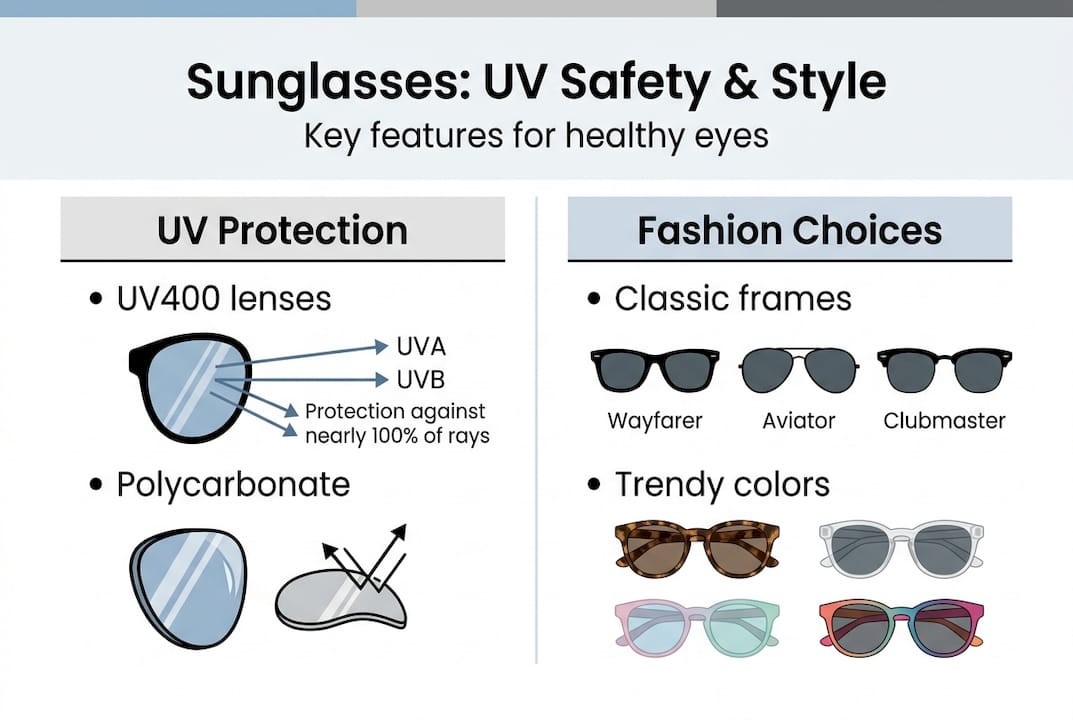
Now that you understand the risks, let’s explore how different sunglasses offer protection, or sometimes fall short. The most important rating to look for is UV400. This means the lenses block 100% of UVA and UVB rays up to 400 nanometres in wavelength, which covers the full spectrum of harmful UV radiation. Dark lenses without a UV400 rating can actually be worse than no sunglasses at all, because your pupils dilate behind tinted lenses, allowing more unfiltered UV to enter.
| Feature | UV400 lenses | Non-UV lenses |
|---|---|---|
| UVA blocking | 100% | Minimal or none |
| UVB blocking | 100% | Minimal or none |
| Glare reduction | Varies | Varies |
| Eye safety | High | Low or negative |
Polarised lenses go a step further. Polarised lenses reduce glare by filtering horizontally reflected light through aligned polymer chains. This is particularly useful on water, snow, and wet roads where glare is intense. The science is straightforward: aligned polymer chains block horizontal light waves while allowing vertical ones through, cutting reflected glare dramatically.
| Lens type | Best for | Glare reduction | UV protection |
|---|---|---|---|
| UV400 standard | Everyday use | Moderate | Full |
| UV400 polarised | Driving, water, snow | High | Full |
| Non-UV tinted | Fashion only | Low | None |
Material also matters. Polycarbonate lenses are impact-resistant, lighter than glass, and naturally block UV. They are a practical choice for active use and for children’s eyewear. Checking UV400 lens features before purchasing is straightforward and worth the extra moment of research.

Pro Tip: Polarised lenses can make LCD screens on phones and dashboards appear dark or invisible at certain angles. If you rely on digital displays while driving or working outdoors, tilt your screen slightly or choose UV400 non-polarised lenses for those specific situations.
When and where is UV protection crucial?
With the different lens technologies in mind, it’s equally crucial to know exactly when and where your eyes are most at risk. Many people are surprised to learn that up to 80% of UV penetrates cloud cover, and snow reflects between 85% and 90% of UV radiation back upwards. That means a grey winter ski day can expose your eyes to more UV than a clear summer afternoon in a shaded garden.
Here are the five situations where sunglasses are non-negotiable:
- Driving: Windscreens filter some UV but not all, and glare from wet roads or low sun is a genuine safety hazard
- Ski trips and winter sports: Snow reflection makes UV exposure extreme, and altitude increases UV intensity further
- At the beach or on water: Water reflects up to 25% of UV, and sand adds additional reflection from below
- Urban walking: Pavements, glass buildings, and car bonnets all reflect UV, particularly around midday
- Children outdoors: Young eyes absorb significantly more UV than adult eyes, making early protection critical
The sunscreen year-round principle applies equally to sunglasses. Skin care specialists have long recommended daily sunscreen regardless of season, and the same logic holds for eye protection. UV accumulates whether or not you notice it.
Exploring sunglass categories for outdoor use helps match the right lens to each activity. For younger wearers, purpose-built UV sunglasses for children provide the coverage and durability needed for active outdoor play.
Stylish and affordable: Sunglass choices for health and fashion
Knowing when to wear them is only half the story. Choosing the right pair makes all the difference, both for your eyes and your look. The good news is that you do not need to spend a significant sum to get proper protection. Affordable sunglasses under £40 regularly offer full UV400 coverage and polarisation when purchased from reputable retailers.
| Style | UV400 | Polarised | Approx. price | Best for |
|---|---|---|---|---|
| Wraparound sport | Yes | Yes | £20 to £35 | Active use, driving |
| Classic aviator | Yes | Optional | £15 to £40 | Everyday, fashion |
| Oversized square | Yes | Optional | £18 to £38 | Maximum coverage, style |
| Kids’ wraparound | Yes | Yes | £12 to £25 | Children, outdoor play |
When choosing a pair, consider these key factors:
- Coverage: Larger lenses and close-fitting frames reduce UV entering from the sides
- Face shape fit: Frames that complement your face shape improve both comfort and appearance
- Material: Polycarbonate lenses offer durability and natural UV resistance
- Reputable seller: Always buy from a verified retailer that provides UV certification
- Comfort: Poorly fitting frames are less likely to be worn consistently, reducing their protective value
Fashion and function genuinely go together at every price point. Guides on how to style sunglasses show how the right pair can anchor an outfit while keeping your eyes safe. A detailed guide to style and fit helps narrow down choices based on face shape, lifestyle, and budget, so you find a pair you will actually reach for every day.
Why smart sunglass choices should be non-negotiable: Our expert take
By now, it’s clear that sunglasses should be seen as a necessity, not a negotiable extra. The most persistent and damaging myth in eye care is that sunglasses are reserved for sunbathing or making a style statement. This thinking leaves eyes unprotected during the very moments, overcast commutes, winter walks, school runs, where UV quietly accumulates.
The practical shift is simple. Treat sunglasses the way you treat a daily skincare routine. You would not skip moisturiser because it is cloudy. The same logic applies here. Wearing sunglasses as part of your style means you are far more likely to wear them consistently, which is the only thing that actually protects your eyes over a lifetime.
Starting protection young is the single most impactful long-term decision a parent can make for a child’s eye health. The damage that leads to cataracts and macular degeneration in later life begins decades earlier.
Pro Tip: Choose UV400 sunglasses you genuinely like the look of. Consistency is everything in eye protection, and you will only wear them daily if you actually want to.
Find your perfect pair: Premium protection meets style
Ready to take action and safeguard your vision without sacrificing style? At 4 Vision, every pair is built around certified UV400 protection and real optical quality, without the inflated price tags that come with luxury branding. Whether you are looking for everyday frames, sport-ready wraparounds, or reading glasses with UV coverage, the range covers every need.
Browse premium eyewear essentials to understand what genuine quality looks like at an honest price. Explore the full unisex reading glasses collection for versatile everyday options, or complete your look with practical eyewear accessories designed to keep your glasses in top condition. Protection and style, at a price that makes sense.
Frequently asked questions
Do sunglasses work on cloudy or snowy days?
Yes. Up to 80% of UV penetrates cloud cover, and snow reflects up to 90% of UV radiation, making sunglasses essential in both conditions.
Should children wear sunglasses regularly?
Yes. Cumulative UV damage can begin in childhood, and early protection significantly reduces the risk of cataracts and other serious eye diseases in later life.
What does UV400 mean on sunglasses?
UV400 blocks 100% of UVA and UVB rays up to 400 nanometres, providing the highest available level of UV eye protection.
Are expensive sunglasses safer than affordable ones?
Not necessarily. Affordable sunglasses under £40 can offer complete UV400 protection and polarisation when purchased from a reputable, certified retailer.