

Why UV400 sunglasses are essential for eye protection
Dark lenses feel protective. They reduce glare, they look the part, and they signal sun-awareness. But wearing non-UV400 sunglasses can actually make eye damage worse. When dark tint blocks visible light without filtering UV rays, your pupils dilate wider, allowing more harmful radiation to reach your retina. Dark lenses without UV400 worsen this by creating a false sense of safety. This article covers how UV radiation harms your eyes over time, what UV400 certification actually means, which groups face the greatest risk, and how to find sunglasses that deliver both genuine protection and style.
Table of Contents
- The science behind UV exposure and eye health
- What makes UV400 special and why other sunglasses fall short
- UV exposure edge cases: children, driving, indirect sunlight
- Style, certification, and practical buying tips for UV400 sunglasses
- The uncomfortable truth about sunglasses: why UV400 labels matter more than style
- Discover stylish, certified UV400 sunglasses at 4 Vision
- Frequently asked questions
Key Takeaways
| Point | Details |
|---|---|
| UV400 blocks all harmful rays | UV400 sunglasses protect your eyes from both UVA and UVB, reducing risks of cataracts and macular degeneration. |
| Dark lenses alone are unsafe | Dark tinted lenses without UV400 can dangerously increase UV exposure by dilating your pupils. |
| Certification matters most | Always check for certified UV400 labelling or retailer guarantees, as style and tint mean little without real protection. |
| Children and drivers at greater risk | Extra vigilance is needed for children or when driving, as their eyes or car windshields do not fully filter UV. |
| Combine style with safety | You can confidently find stylish sunglasses that meet UV400 standards, protecting your health while complementing your look. |
The science behind UV exposure and eye health
UV radiation is invisible, but its effects on your eyes are very real. The damage builds slowly, year after year, often without any immediate symptoms. By the time problems appear, significant harm may already have occurred.
The main conditions linked to UV exposure include:
- Cataracts: Clouding of the eye’s lens, the leading cause of preventable blindness worldwide
- Age-related macular degeneration (AMD): Deterioration of the central retina, causing loss of sharp vision
- Photokeratitis: Essentially sunburn of the cornea, causing temporary but painful vision disturbance
- Pterygium: Abnormal tissue growth across the white of the eye
- Eyelid skin cancers: Often overlooked, the thin skin around the eye is highly UV-sensitive
UV exposure causes cumulative damage leading to cataracts, macular degeneration, photokeratitis, pterygium, and eyelid skin cancers. Empirical studies confirm that high UV exposure significantly increases the risk of both cataracts and AMD.
Expert warning: Wearing dark sunglasses without UV400 certification is more dangerous than wearing no sunglasses at all. Dilated pupils in dim conditions allow far greater UV penetration to the retina.
For anyone spending time outdoors, whether walking, cycling, driving, or simply sitting in a garden, the risks of UV exposure are not seasonal. UV rays are present year-round, even on overcast days. Understanding this is the first step toward making genuinely protective choices. Learning more about UV protection in sunglasses helps clarify what to look for before you buy.
What makes UV400 special and why other sunglasses fall short
UV400 is a specific standard. It means the lenses block all ultraviolet radiation up to 400 nanometres (nm) in wavelength. That covers both UVA (315 to 400nm) and UVB (280 to 315nm) rays completely. No partial filtering. No gaps.
Standard tinted sunglasses, particularly cheaper options, often block visible light without addressing UV at all. The tint is cosmetic. It reduces brightness but offers no meaningful protection against the radiation that causes eye disease.
| Feature | UV400 certified | Standard tinted | Cheap unrated |
|---|---|---|---|
| Blocks UVA rays | Yes, 100% | Partial or none | None |
| Blocks UVB rays | Yes, 100% | Partial | None |
| Reduces glare | Yes | Yes | Yes |
| Certified label | Required | Rarely | Never |
| Safe for prolonged outdoor use | Yes | No | No |
The table above makes the gap clear. Style and darkness of tint tell you nothing about UV protection. A pale, lightly tinted lens with UV400 certification protects your eyes far better than a very dark lens without it.
Exploring the range of sunglass categories available helps match protection level to activity. UV ratings explained in detail show why certification is the only reliable indicator of safety.
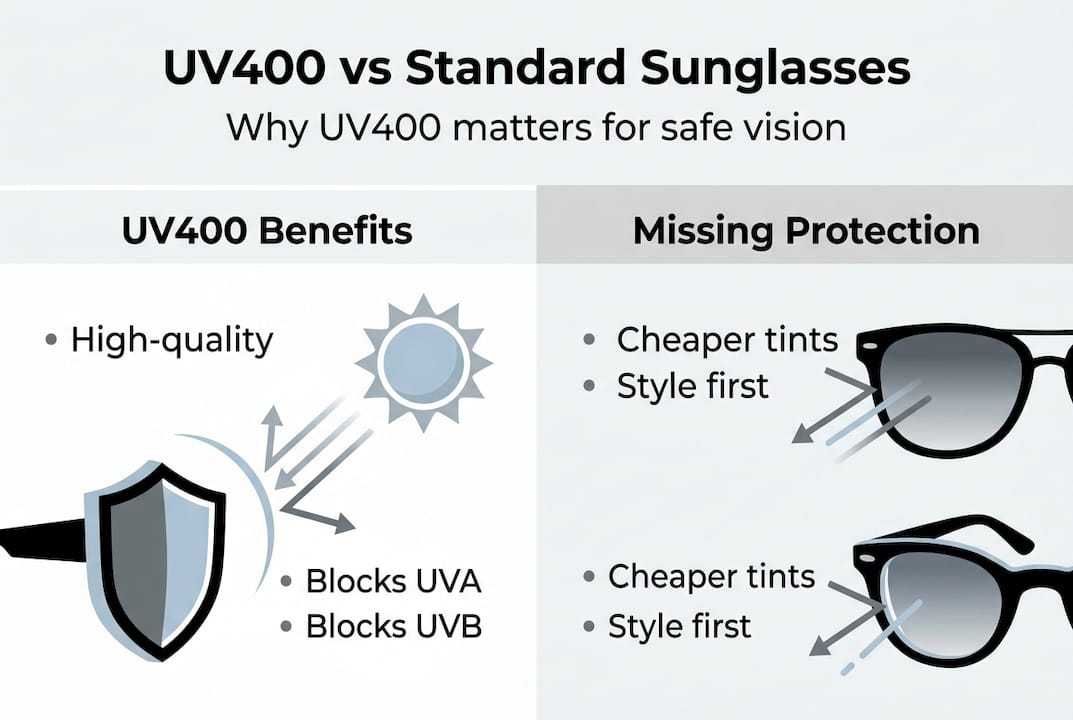
UV400 is essential for health-conscious users engaging in outdoor activities. Prioritise certified labels over tint, darkness, or style every time.
Pro Tip: If you are unsure whether your current sunglasses offer UV400 protection, take them to an optician. Many will test lenses for free. As UV400 certification costs far less than cataract surgery or vision loss treatment, it is genuinely cheap insurance.
UV exposure edge cases: children, driving, indirect sunlight
Even with quality sunglasses, certain groups and situations carry greater risk than most people realise. Awareness of these edge cases is where real protection begins.
Children are particularly vulnerable. A child’s crystalline lens is clearer and more transparent than an adult’s, meaning it filters far less UV radiation. Children’s eyes filter less UV, making them significantly more susceptible to cumulative damage from early in life. Fitting children with certified UV sunglasses for children is one of the most impactful protective steps a parent can take.
Drivers face a specific gap in protection. Car windscreens block most UVB radiation, but they do not block all UVA. Side windows typically offer even less protection. Regular driving without UV400 sunglasses exposes the eyes to meaningful UVA levels over years of commuting.
Indirect and reflected sunlight is widely underestimated. Consider the following UV penetration data:
| Surface or condition | UV penetration or reflection |
|---|---|
| Overcast cloud cover | Up to 80% UV passes through |
| Fresh snow | Reflects 80 to 85% of UV |
| Water surfaces | Reflects up to 100% of UV |
| Urban concrete and glass | Reflects 10 to 25% of UV |
Actions to protect children and drivers specifically:
- Fit children with certified UV400 sunglasses from an early age, not just in summer
- Choose wrap-around styles to reduce UV entering from the sides
- Apply UV400 sunglasses when driving, regardless of windscreen tinting
- Wear sunglasses on overcast days, especially near water or snow
- Replace sunglasses that lack a certified UV400 label, regardless of how dark the tint appears
For everyday outdoor use, guidance on UV protection for everyday activities provides practical context beyond seasonal wear.
Style, certification, and practical buying tips for UV400 sunglasses
Finding UV400 sunglasses that look good is straightforward once you know what to check. The market offers a wide range of styles, from classic aviators to modern sport frames, all available with full UV400 certification.
What to look for when buying:
- UV400 label: Printed on the lens, tag, or frame. Non-negotiable.
- CE or ANSI certification marks: These indicate the product has been tested to recognised safety standards in the UK and USA respectively
- Lens category rating: Categories 0 to 4 indicate tint level. Category 3 suits most outdoor use. Category 4 is for extreme conditions such as high-altitude skiing
- Frame coverage: Larger frames and wrap-around styles reduce UV entering from the sides and above
- Polarisation: Reduces glare from reflective surfaces but does not indicate UV protection on its own
Common buying pitfalls to avoid:
- Assuming price equals protection. Expensive fashion sunglasses without UV400 certification offer no UV benefit.
- Trusting darkness of tint as a proxy for UV filtering. It is not.
- Buying online from unverified sellers who list no certification information
Certified labels matter more than tint or style when choosing genuinely protective sunglasses. Guidance on buying sunglasses online covers how to verify sellers and spot misleading product descriptions. A clear shopping workflow for sunglasses makes the process faster and more reliable. If you are considering a longer-term investment, understanding why to upgrade sunglasses for durability is worth reading before you commit.
Pro Tip: When shopping in-store, ask the retailer directly for the UV400 certification document or label. Any reputable seller will have it. If they cannot provide it, walk away. The UV400 meaning explained in detail gives you the language to ask the right questions confidently.
The uncomfortable truth about sunglasses: why UV400 labels matter more than style
There is a pattern worth naming directly. Most people choose sunglasses based on how they look. Retailers know this, and many lean into it, showcasing frame shapes, colour options, and celebrity endorsements while burying or omitting UV certification details entirely.
The result is a market where genuinely protective eyewear and fashionable eyewear are treated as separate categories. They are not. UV400 certification is available across every style and price point. The choice to prioritise it costs nothing extra.
For UK and USA outdoor enthusiasts specifically, the standard of protection matters. Both countries have strong UV index levels during summer months, and both have populations that spend significant time outdoors. UV400 is essential for health-conscious users in these markets engaging in outdoor activities.
The contrarian advice here is simple. Stop letting style lead the decision. Start with certification, then choose the frame you like best from the certified options. UV protection in stylish sunglasses shows that the two are not in conflict. You do not have to sacrifice one for the other.
Discover stylish, certified UV400 sunglasses at 4 Vision
Knowing what to look for is only useful if you can find it easily. At 4 Vision, every pair of sunglasses in the range carries UV400 certification, so you are not left guessing about protection levels.
The full collection of stylish UV400 sunglasses covers a wide range of frame styles, sizes, and lens types, suitable for everyday wear, sport, driving, and travel. For those seeking higher-specification options, the premium eyewear range offers enhanced lens technology and frame materials without the inflated markups of luxury brands. Fast delivery, transparent pricing, and carbon-neutral shipping are standard across all orders.
Frequently asked questions
What does UV400 mean for sunglasses?
UV400 means the lenses block 100% of UV rays up to 400 nanometres, covering both UVA and UVB radiation completely. Certified UV400 labels are the only reliable indicator of full UV protection.
Do dark-tinted sunglasses protect my eyes if they lack UV400?
No. Dark tint without UV400 causes pupils to dilate, allowing more UV radiation into the eye and increasing the risk of damage. Dark lenses without UV400 actively worsen exposure.
How can I check if my sunglasses are truly UV400 protected?
Look for a UV400 label on the lens or frame, or ask an optician to test them. Testing at an optician is a simple, often free step that confirms protection before damage occurs.
Are children more vulnerable to UV damage than adults?
Yes. Children’s eyes filter less UV than adult eyes, making them more susceptible to cumulative UV damage from an early age. Certified UV400 sunglasses are recommended from childhood onwards.