

What is designer eyewear explained: style meets quality
Many believe designer eyewear simply means paying extra for a luxury logo. That’s a costly misconception. True designer eyewear combines premium materials like acetate and titanium with precision craftsmanship and ergonomic design that regular frames lack. Affordable brands now deliver this quality without inflated markups, making style and durability accessible. This guide explains what designer eyewear truly entails, how manufacturing processes create tangible differences, and how you can choose authentic, high-quality frames that suit your style and budget in the UK and USA markets.
Table of Contents
- Key takeaways
- What defines designer eyewear?
- Material and manufacturing quality in designer eyewear
- Quality standards and lens choices for designer eyewear
- Affordable designer eyewear brands for UK and USA shoppers
- Explore premium and stylish eyewear options
- Frequently asked questions about designer eyewear
Key Takeaways
| Point | Details |
|---|---|
| Designer eyewear essence | Designer eyewear combines fashion sensibility, engineering precision and material excellence beyond basic frames. |
| Premium materials and fit | It uses premium materials such as acetate and titanium with meticulous construction and ergonomic design that regular frames lack. |
| Manufacturing standards | Designer frames undergo rigorous quality checkpoints and advanced techniques to deliver lasting durability and reliable fit. |
| Brand authentication | Check authenticity certificates and serial numbers on the temples to verify genuine designer eyewear, especially when buying online. |
What defines designer eyewear?
Designer eyewear refers to optical frames and sunglasses created with a focus on style, craftsmanship, brand identity, and customer experience, often from fashion houses like Gucci, Prada, or premium independents like Oliver Peoples. These pieces go beyond basic vision correction. They represent a fusion of fashion sensibility, engineering precision, and material excellence that transforms eyewear into a statement accessory.
Brand identity plays a crucial role for style-savvy consumers who want their eyewear to reflect personal taste. Designer frames showcase distinctive aesthetics, from bold geometric shapes to minimalist elegance, each telling a visual story. The ethos behind these brands emphasises attention to detail, from initial sketch to final polish, creating products that feel as good as they look.
What separates designer eyewear from simple fashion eyewear or budget options? Several core qualities stand out:
- Premium material selection that ensures longevity and skin-friendly wear
- Meticulous construction processes with multiple quality checkpoints
- Ergonomic engineering for balanced weight distribution and comfort
- Distinctive design language that sets trends rather than follows them
- Customer service and warranty support that backs product claims
For UK and USA markets, recognisable names include Ray-Ban, Tom Ford, and Persol, alongside emerging independents that prioritise craftsmanship. These brands invest in premium eyewear features like spring hinges, adjustable nose pads, and hand-finished temples. The result? Frames that maintain their shape after years of daily wear, lenses that resist scratches, and styles that remain relevant beyond seasonal trends.
Designer eyewear also delivers an elevated customer experience. Packaging, documentation, and after-sales support reflect the brand’s commitment to quality. When you invest in designer frames, you’re not just buying a product but accessing expertise, from fit consultations to lens customisation options that standard retailers rarely offer.
Pro Tip: Check for brand authentication certificates and serial numbers on temples to verify genuine designer eyewear, especially when buying online or through third-party retailers.
Material and manufacturing quality in designer eyewear
Material choice fundamentally shapes eyewear performance and comfort. Designer frames typically use acetate, titanium, or stainless steel, while regular glasses often rely on injection-moulded plastic. Acetate, derived from plant-based cellulose, offers rich colour depth and hypoallergenic properties. Titanium provides exceptional strength-to-weight ratios, making frames incredibly light yet durable. Stainless steel delivers corrosion resistance and flexibility for active lifestyles.
Key differences from regular eyewear include premium materials like acetate, titanium, and stainless steel versus injection plastic, better ergonomic fit, smoother hinges, and higher durability. These materials respond differently to temperature changes, skin oils, and daily stress. Acetate maintains its lustre and shape over time, whilst cheap plastic becomes brittle and discoloured. Titanium frames flex without breaking, absorbing impact that would snap standard metal alloys.

Manufacturing involves 3D CAD design, CNC cutting and milling for acetate, injection moulding for TR90, tumbling and polishing, manual assembly, and quality tests like dimensional stability and endurance per ISO 12870 standards. This multi-stage process ensures every frame meets precise specifications. CNC milling carves acetate blocks with micrometre accuracy, creating perfectly symmetrical frames. Tumbling smooths edges and removes microscopic imperfections. Manual assembly allows skilled technicians to adjust hinge tension and alignment, something automated lines cannot replicate.
| Manufacturing Stage | Purpose | Quality Impact |
|---|---|---|
| 3D CAD design | Creates precise digital templates | Ensures consistent measurements across production |
| CNC milling | Cuts acetate with micrometre accuracy | Eliminates warping and asymmetry |
| Injection moulding | Forms TR90 frames under controlled heat | Produces lightweight, flexible frames |
| Tumbling and polishing | Smooths surfaces and edges | Prevents skin irritation and enhances appearance |
| Manual assembly | Adjusts hinges and alignment by hand | Guarantees proper fit and smooth operation |
| ISO 12870 testing | Validates dimensional stability and endurance | Confirms frames withstand daily wear |
Ergonomic design features distinguish designer eyewear from mass-market alternatives. Nose bridges contour to facial structure, distributing weight evenly to prevent pressure points. Temple arms curve naturally behind ears, maintaining position without excessive grip. Spring hinges flex outward, accommodating different head sizes whilst returning to original position. These details prevent the headaches and red marks common with poorly fitted frames.
Quality checks verify that frames meet ISO 12870 standards, testing dimensional stability under temperature extremes and mechanical endurance through repeated opening and closing cycles. Frames must maintain their shape after thousands of flexes, proving they’ll survive years of use. This rigorous testing separates designer eyewear from budget options that fail after months.
Durability benefits extend beyond frame longevity. Premium materials resist scratches, chemical damage from cosmetics and sunscreen, and UV degradation that yellows plastic. The smooth user experience comes from precisely machined components that operate without squeaking or catching. When you adjust designer frames, hinges move fluidly rather than sticking or loosening over time.
Pro Tip: Look for frames with barrel hinges rather than integrated hinges, as they’re easier to repair and adjust, extending the life of your investment significantly.
Explore premium eyewear what is it really to understand how material choices and manufacturing precision create tangible value in daily wear.
Quality standards and lens choices for designer eyewear
Safety and optical performance standards ensure designer eyewear protects your vision whilst delivering clarity. ANSI Z80.3 compliance sets benchmarks for impact resistance, optical quality, and UV protection in the USA, whilst ISO standards govern international markets. These certifications aren’t optional extras but fundamental requirements that separate legitimate eyewear from fashion accessories masquerading as protective gear.
Quality benchmarks include ANSI Z80.3 compliance, UV400, and impact resistance, with Trivex outperforming polycarbonate in clarity and impact per tests, alongside standards like ISO 12870 for frames. UV400 protection blocks 100% of UVA and UVB rays up to 400 nanometres, preventing cataracts and macular degeneration. Impact resistance testing drops steel balls onto lenses from specific heights, ensuring they withstand everyday accidents without shattering.
Lens material selection significantly affects visual experience and safety. Trivex and polycarbonate dominate the premium eyewear market, each offering distinct advantages. Trivex provides superior optical clarity with minimal chromatic aberration, making it ideal for prescription lenses where distortion-free vision matters. Its impact resistance exceeds polycarbonate whilst weighing less, reducing nose pressure during extended wear. Polycarbonate offers excellent impact protection at a lower cost, making it popular for children’s eyewear and sports applications.
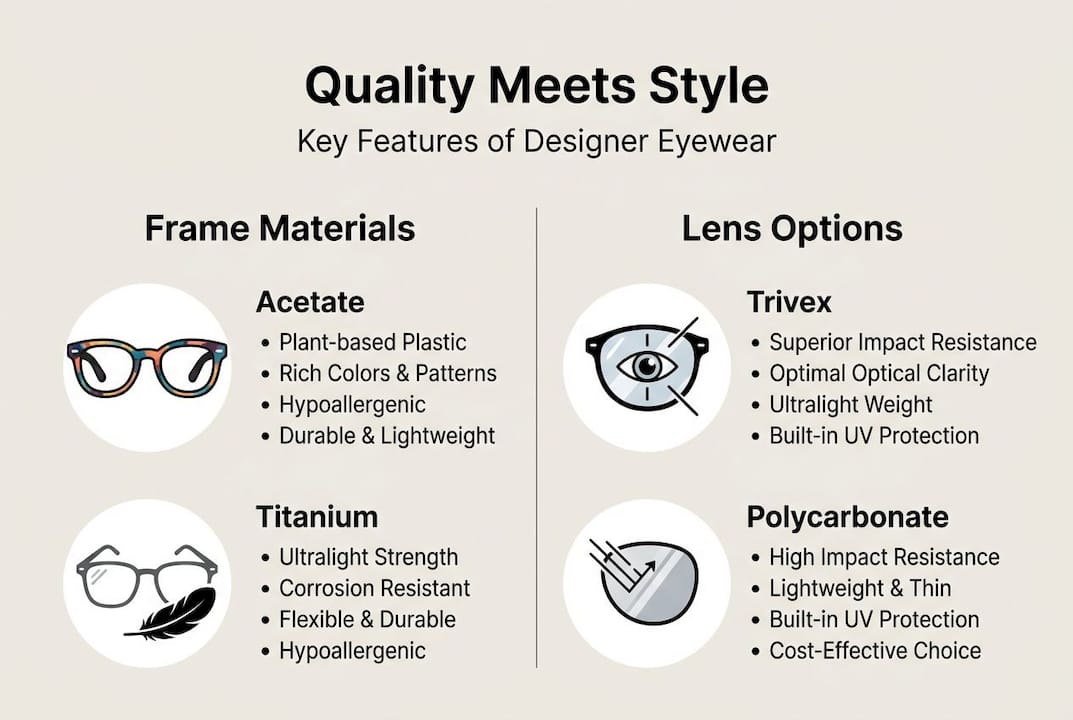
| Lens Material | Optical Clarity | Impact Resistance | Weight | Best For |
|---|---|---|---|---|
| Trivex | Excellent (low chromatic aberration) | Superior | Very light | Prescription lenses, all-day wear |
| Polycarbonate | Good (slight distortion) | Excellent | Light | Sports, children’s eyewear, budget-conscious |
| CR-39 plastic | Very good | Moderate | Moderate | Non-prescription sunglasses |
| High-index | Excellent | Moderate | Light | Strong prescriptions |
Tested durability ensures lenses resist scratches from daily handling and chemical exposure from cleaning products. Designer eyewear typically includes scratch-resistant coatings that extend lens life significantly. Anti-reflective treatments reduce glare from screens and headlights, improving visual comfort. Hydrophobic coatings repel water and oils, keeping lenses cleaner longer.
Wearer comfort depends on matching lens material to frame design. Heavy glass lenses in lightweight titanium frames create imbalance, whilst Trivex lenses in acetate frames distribute weight naturally. Designer brands engineer these pairings carefully, ensuring frames and lenses work together harmoniously. This integration prevents the nose-sliding and temple-pinching that plague mismatched eyewear.
Choosing lenses that complement designer frames requires understanding your needs. Active lifestyles demand impact-resistant polycarbonate or Trivex. Office workers benefit from anti-reflective coatings that reduce eye strain. Outdoor enthusiasts need polarised lenses that cut glare from water and snow. Designer eyewear accommodates these variations whilst maintaining aesthetic integrity.
Pro Tip: Request lens thickness estimates before ordering prescription lenses in designer frames, as high prescriptions can create unsightly edges that detract from frame aesthetics.
Understand why eyewear fit matters to ensure your lens choices work with frame geometry for optimal comfort and vision.
Affordable designer eyewear brands for UK and USA shoppers
Accessible brands now deliver designer aesthetics and quality materials without luxury house price tags. Direct-to-consumer models eliminate retailer markups, passing savings to customers whilst maintaining manufacturing standards. For UK and USA style-savvy consumers, affordable high-quality options include Warby Parker at $95 plus, Ollie Quinn at £75 plus frames, and MONC at $310 plus bio-acetate, offering designer-like style without full luxury markup.
Warby Parker revolutionised eyewear retail by offering home try-on programmes and transparent pricing. Their acetate frames rival luxury brands in finish and durability, with spring hinges and adjustable nose pads as standard. Ollie Quinn focuses on British design sensibilities, creating frames that balance classic shapes with contemporary colour palettes. MONC emphasises sustainability through bio-acetate derived from renewable resources, appealing to environmentally conscious consumers who refuse to compromise on style.
Price ranges reflect different value propositions:
- Entry-level designer-style frames: £60 to £120 or $80 to $150, offering quality materials and basic customisation
- Mid-range premium brands: £120 to £250 or $150 to $300, featuring advanced materials and extensive style options
- Accessible luxury: £250 to £400 or $300 to $500, delivering near-luxury quality with emerging brand cachet
Direct-to-consumer brands reduce luxury markup by controlling distribution and manufacturing. Traditional designer eyewear passes through multiple intermediaries, each adding margin. By selling directly online, these brands invest savings in better materials and customer service. Virtual try-on technology and generous return policies mitigate the risk of buying without physically trying frames.
Evaluating authenticity and quality when buying requires systematic assessment:
- Verify brand credentials through official websites and authorised retailer lists
- Examine material specifications, looking for acetate, titanium, or stainless steel construction
- Check for quality certifications like ISO 12870 and ANSI Z80.3 compliance
- Read independent reviews focusing on durability and customer service experiences
- Confirm return policies and warranty coverage before purchasing
Selecting styles that suit personal fashion starts with understanding face shape and colouring. Round faces benefit from angular frames that add definition. Square faces soften with rounded or oval shapes. Oval faces accommodate most styles, allowing experimentation. Skin tone influences colour choices, with warm undertones suiting tortoiseshell and gold, whilst cool undertones pair well with black and silver.
Discover fashionable glasses style 2026 to identify current trends that complement your features. Learn how to buy sunglasses online for style and quality to make confident purchases. Browse sunglasses stylish options to see how premium design translates across price points.
Explore premium and stylish eyewear options
Now that you understand what separates designer eyewear from ordinary frames, it’s time to experience that quality firsthand. 4 VISION curates collections that combine fashion-forward design with premium materials, delivering the craftsmanship and durability this guide describes.
Our sunglasses and reading glasses collections feature acetate frames, spring hinges, and UV400 protection as standard. Every piece undergoes quality checks ensuring it meets the standards discussed here. Whether you need prescription lenses or non-prescription sunglasses, our range offers styles that suit your face shape and personal aesthetic. Explore premium eyewear what is it really to see how we define quality, browse our sunglasses collection for protective style, or discover premium reading glasses that make close work comfortable. With transparent pricing, detailed product specifications, and customer service that answers your questions, finding eyewear that matches your expectations becomes straightforward.
Frequently asked questions about designer eyewear
What makes eyewear ‘designer’?
Designer eyewear combines premium materials like acetate or titanium with precision manufacturing processes and distinctive aesthetic design from recognised fashion brands or independents. It meets rigorous quality standards including ISO 12870 for frames and ANSI Z80.3 for lenses, ensuring durability and optical performance beyond basic eyewear.
How to spot authentic designer frames?
Authentic designer frames include brand markings etched inside temples, serial numbers for registration, and come with certificates of authenticity and branded packaging. Check the brand’s official website for authorised retailers, examine construction quality like smooth hinges and even colour distribution, and verify warranty coverage that legitimate brands always provide.
Are affordable designer-style brands trustworthy?
Many affordable brands deliver genuine quality through direct-to-consumer models that eliminate retailer markups rather than cutting manufacturing corners. Verify they use proper materials like acetate or titanium, meet safety standards like UV400 protection, offer transparent return policies, and have positive independent reviews focusing on durability and customer service rather than just style.
What materials are best for durability and comfort?
Acetate offers hypoallergenic properties and rich colours whilst maintaining shape over years. Titanium provides exceptional strength at minimal weight, ideal for sensitive skin and active wear. Stainless steel delivers flexibility and corrosion resistance. For lenses, Trivex combines superior clarity with impact resistance, outperforming polycarbonate in optical quality whilst matching its safety benefits.
Can designer eyewear offer prescription lenses?
Most designer frames accommodate prescription lenses, with opticians able to fit single-vision, bifocal, or progressive lenses depending on frame geometry. Ensure frames have sufficient depth and width for your prescription strength, as high prescriptions create thicker lens edges that may not suit all frame styles. Consult with opticians about lens material choices like Trivex or high-index that minimise thickness in designer frames.
Recommended
- Premium eyewear features: style meets durability in 2026 – 4 VISION
- How to buy sunglasses online for style and quality – 4 VISION
- Why fast delivery matters for stylish eyewear in 2026 – 4 VISION
- Premium Eyewear: Discover the True Essence of Quality – 4 VISION
- Designer Clothing Explained: Prestige, Quality, Value – Designerlabelsale